
Direction
03
Transferable Representation Learning
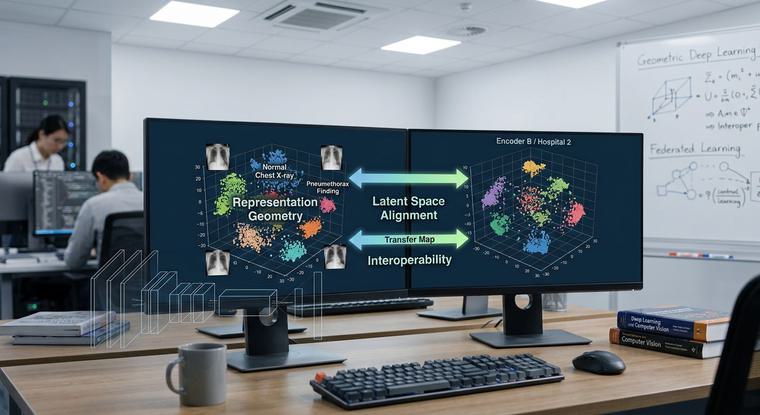
We study how models learn representations that transfer across datasets, domains, institutions, and learning settings. Our work investigates how factors such as self-supervision, model scale, resolution, privacy, and distributed training shape these representations and their ability to generalize.
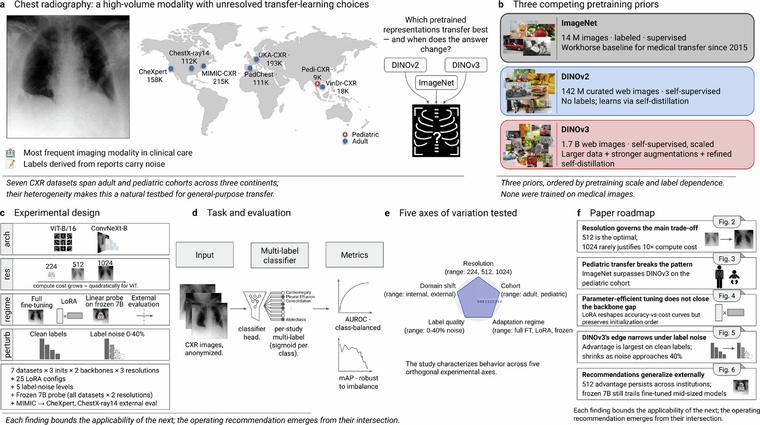
Communications Medicine, 2026
Across 816,183 radiographs from 7 datasets, DINOv3 was not consistently better than DINOv2 or supervised ImageNet initialization at 224 pixels. At 512 pixels it became the strongest initialization, above all with ConvNeXt-B, and the gains concentrated in small focal findings while the pediatric cohort gained nothing. Scaling to 1024 pixels rarely helped for the compute it cost, so fully adapted mid-sized models at 512 pixels gave the best performance-cost trade-off.
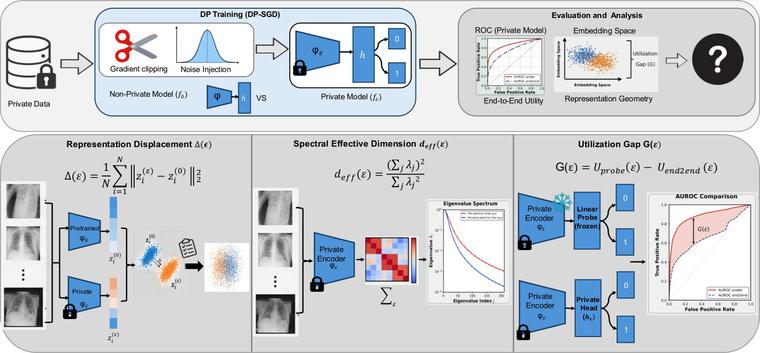
MICCAI 2026
The study measures what differential privacy does to the learned representation and not only to the end-task accuracy, using the geometry of the features in place of an end-task score.
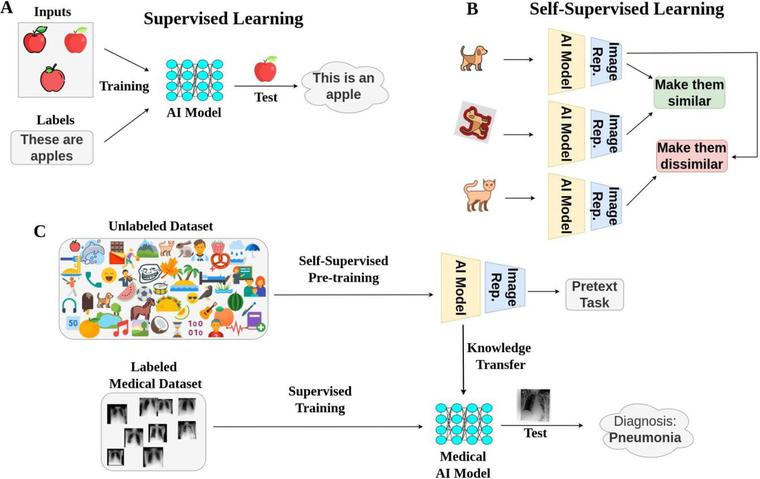
European Radiology Experimental, 2024
Self-supervised pretraining on non-medical images exceeded supervised ImageNet pretraining and, for some findings, supervised medical pretraining. A transferable radiology representation therefore does not need medical data to learn from.
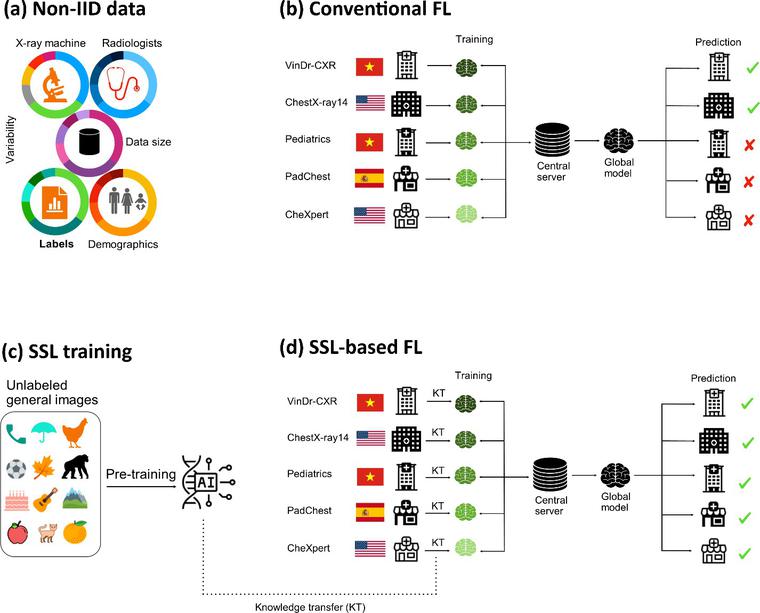
European Journal of Radiology Artificial Intelligence, 2025
Plain federated learning improved the smaller adult datasets and degraded the larger datasets and the pediatric cases. Initializing the same federation from general-purpose self-supervised weights recovered that loss and improved the pediatric cases. General-purpose representations are therefore a practical answer to the non-IID problem in clinical federation.