
Direction
01
Evidence-Grounded and Verifiable Clinical AI
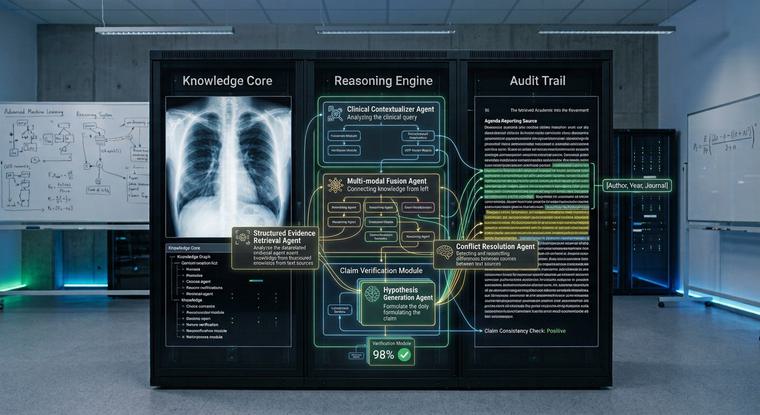
We develop agentic AI systems that can reason over clinical questions, retrieve relevant evidence, and carry out complex analytical workflows with minimal human intervention. Our work focuses on making these systems verifiable and robust by grounding their outputs in external evidence, measuring reliability across models, and studying how factors such as hallucinations and cognitive bias affect clinical decision support.
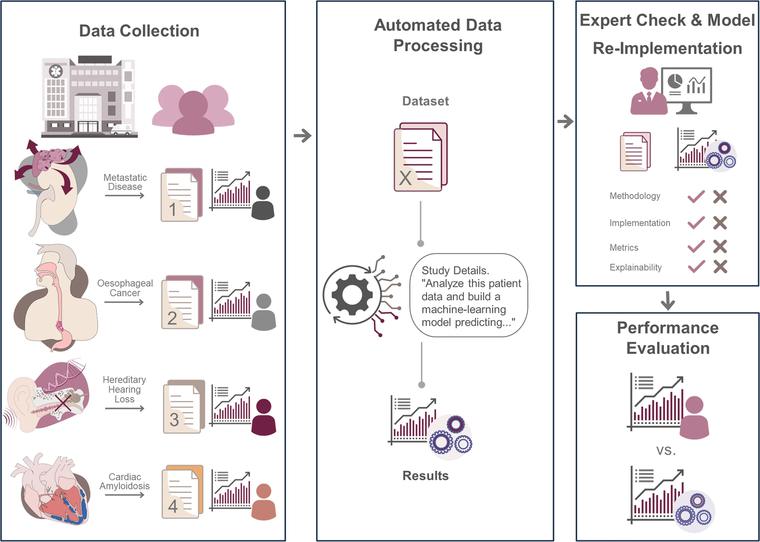
Nature Communications, 2024
A large language model runs the whole machine-learning pipeline for a clinical study from a written brief, choosing the preprocessing, training the models, evaluating them, and explaining the result. Its results matched pipelines that experts reimplemented by hand, and often exceeded the AUROCs published for the same tasks.
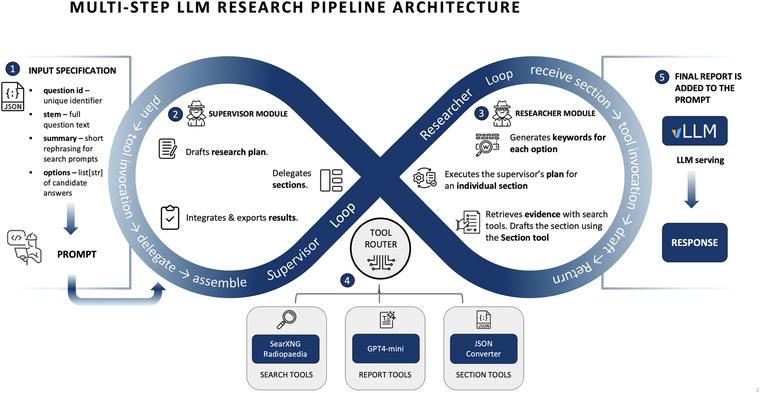
npj Digital Medicine, 2025
The framework decomposes a radiology question, retrieves Radiopaedia evidence for each part, and synthesizes a grounded answer through structured reasoning. Mean accuracy rose from 67% zero-shot and 69% with conventional retrieval to 75%. The gain was largest in small and mid-sized models, and hallucinations fell to a mean of 9.4%.
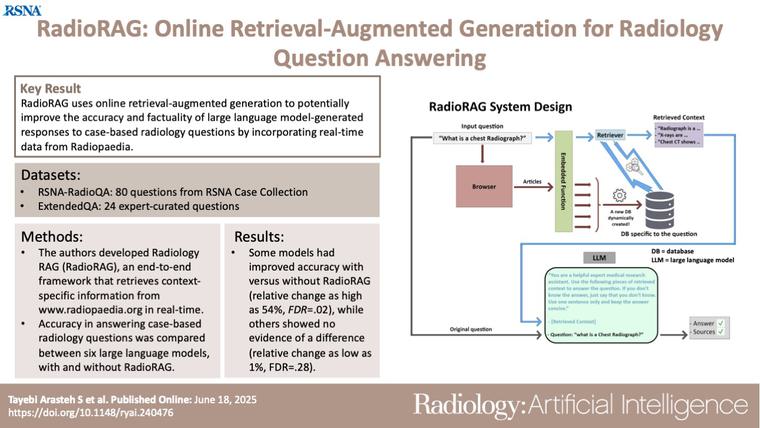
Radiology: Artificial Intelligence, 2025
RadioRAG queries Radiopaedia in real time instead of a fixed corpus and grounds the answer in what it retrieves. On RSNA-RadioQA, accuracy rose from 66% to 74% for GPT-3.5-turbo and from 65% to 76% for Mixtral 8x7B, and both exceeded the human expert at 63%. Hallucinations fell for every model.
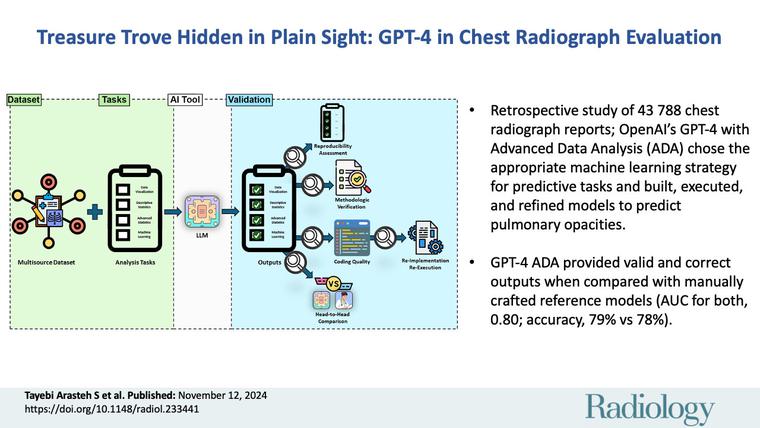
Radiology, 2024
Given only a written brief, a general-purpose model produced visualizations, descriptive statistics, regression analyses, and gradient-boosted predictors on a multisource chest radiograph cohort. Its predictor matched the reference model built by hand, at an AUC of 0.80.
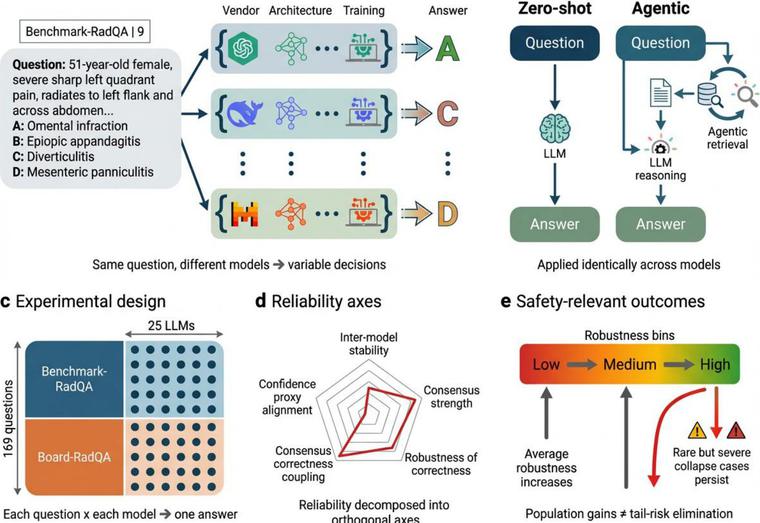
Patterns, Cell Press, 2026
The evaluation measures collective reliability across models instead of the accuracy of a single model. Agentic retrieval reduced the dispersion between models and raised consensus, but high agreement did not make an answer correct. Models fail together and still look confident.